Thursday, 22 August 2013

MINERALS AND POWER RESOURCES IN INDIA


MINERALS AND POWER RESOURCES IN INDIA
Minerals : Geologists define mineral as a “homogenous, naturally occurring substance with a definable internal structure.”
Ore:  Accumulation of minerals mixed with other elements.
Some facts:
Hardest - diamond
Softest – talc
Human mineral intake represents only about 0.3 per cent of our total intake of nutrients, they are so potent and so important that without them we would not be able to utilise the other 99.7 per cent of foodstuffs.
Toothpaste cleans your teeth. Abrasive minerals like silica, limestone, aluminium oxide and various phosphate minerals do the cleaning.
Fluoride which is used to reduce cavities, comes from a mineral fluorite.
Toothpaste are made white with titanium oxide, which comes from minerals called rutile, ilmenite and anatase.
The sparkle in some toothpastes comes from mica.
The toothbrush and tube containing the paste are made of plastics from petroleum.
Over 2000 minerals have been identified, only a few are abundantly found in most of the rocks.
Classification of minerals:


MODE OF OCCURRENCE OF MINERALS
In igneous and metamorphic rocks:
Minerals may occur in the cracks, crevices, faults or joints. The smaller occurrences are called veins and the larger are called lodes.

In sedimentary rocks:
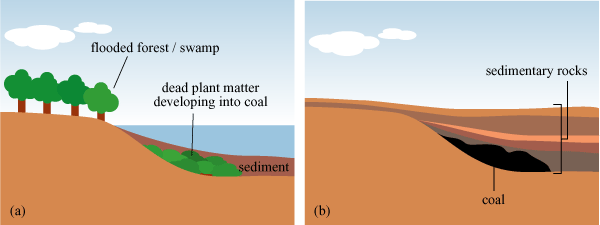
A number of minerals occur in beds or layers. They have been formed as a result of deposition,
accumulation and concentration in horizontal strata. Example Coal
Another group of sedimentary minerals include gypsum, potash salt and sodium salt. These are formed as a result of evaporation especially in arid regions.
In weathered material:
Occur due to the decomposition of surface rocks, and the removal of soluble constituents, leaving a residual mass of weathered material containing ores. Example- Bauxite


In ‘placer deposits’:
Minerals may occur as alluvial deposits in sands of valley floors and the base of hills. Generally contain minerals, which are not corroded by water. Gold, silver, tin and platinum.

In the ocean waters:
Common salt, magnesium and bromine are largely derived from ocean waters. The ocean beds, too, are rich in manganese nodules.

Distribution of mineral in India
India have fairly rich and varied mineral resources but unevenly distributed.
Peninsular rocks contain most of the reserves of coal, metallic minerals, mica and many other non-metallic minerals.
 Sedimentary rocks on the western and eastern flanks of the peninsula, in Gujarat and  Assam have most of the petroleum deposits.
Rajasthan with the rock systems of the peninsula, has reserves of many non-ferrous minerals.
The vast alluvial plains of north India are almost devoid of economic minerals.


S.NO.
Name  of mineral / Power Resource
Features
Largest producers
Availabilty in India
Area
1
Iron ore
Magnetite - 70 per cent.
Hematite - 50-60 per cent
Limonite,
Siderite.
Odisha – 33%
Jharkhand – 28%
abundant
1.Odisha-Jharkhand belt
(i) Badampahar mines in the Mayurbhanj and Kendujhar
districts.
(ii) Gua and Noamundi in Singbhum district of Jharkhand

2. Durg-Bastar-Chandrapur belt(Chhattisgarh and Maharashtra.)
(i) Bailadila range of hills in the Bastar district of Chhattisgarh.


3.Bellary-Chitradurga-Chikmaglur-Tumkur belt in Karnataka:Kudremukh deposits are known to be one of the largest in the world.

4. Maharashtra-Goa belt: Goa and Ratnagiri district of Maharashtra.
2
Manganese
Nearly 10 kg of manganese is required to manufacture one tonne of steel.
Odisha- 25%
M.P- 24%
Karnataka- 22%
( 2009-10)
3
Copper
Rajasthan- 48%
M.P- 29%
Jharkhand- 16%
1. Khetri mines in Rajasthan
2. Balaghat mines and Malanjkhand  in Madhya Pradesh,
3. Singhbhum district of Jharkhand
4
Bauxite
It is from bauxite, a
clay-like substance
that alumina and later aluminium is
obtained.
Odisha- 34%
1. Panchpatmalideposits in Koraput district ( Odisha)

2. Amarkantak plateau, Maikal hills and the plateau region of Bilaspur-Katni.(M.P and Chattisgarh)
5
Mica
Mica is made up of a series of sheets. A thousand can be layered into a mica sheet of a few cm. high.
Jharkhand
India largest producer
1. Koderma Gaya – Hazaribagh belt of Jharkhand
2. Ajmer and Beawar  in Rajasthan
3. Nellore in Andhra Pradesh
6
Limestone
Limestone is the basic raw material
for the cement industry and essential for
smelting iron ore in the blast furnace.
Karnataka- 30%
Andhara- 20%
7
Coal
Types:
1. Peat
2. Lignite
3. Bituminous
4. Anthracite- Highest quality
Abundantly found fossil fuel
1. Gondwana fields (200 million years in age)
2. Tertiary fields(55 million years
Old)

Gondwana fields:
i. Damodar valley:
(a) Jharia ( Jharkhand)
(b) Raniganj ( West Bengal)
(c) Bokaro( Jharkhand)
ii. Talcher in Odisha
iii.Singareni in Andhara
iv. Korba in Chattishgarh
v. Nevyli in Tamilnadu

 Tertiary fields:
North eastern states of Meghalaya, Assam, Arunachal Pradesh and Nagaland.
8
Petroleum
Petroleum
refineries act as a “nodal industry” for
synthetic textile, fertiliser and numerous
chemical industries.
1. Maharashtra- 63%
2. Gujarat- 18%
3. Assam-16%
Most of the petroleum occurrences in India are associated with anticlines and fault traps in the rock formations of the tertiary age.

1. Mumbai High in Maharashtra
2. Ankeleshwar in Gujarat
3. Digboi, Naharkatiya and Moran-Hugrijan in Assam
4. Barmer,  Rajasthan
9
Natural gas
Energy resource and industrial raw material in the
petrochemical industry.
The 1700 km long Hazira-Vijaipur -
Jagdishpur cross country gas pipeline links Mumbai High and Bassien with the fertilizer,
power and industrial complexes in western and
northern India.
1. Krishna- Godavari basin.
2. Mumbai High
3. Gulf of Cambay.
4. Andaman and Nicobar islands
10
Thermal power
Thermal electricity is generated by using coal, petroleum and natural gas.
There are over 310 thermal power plants in India.
-
11
Nuclear power
Nuclear power plants:
1.Naraura- U.P
2.Rawat Bhata- Rajasthan
3. Kakrapara- Gujarat
4. Tarapur- Maharashtra
5.Kaiga- Karnataka
6. Kalpakkam- Tamilnadu
1. Uranium and Thorium, are available in Jharkhand and theAravalli ranges of Rajasthan

2. The Monazite sands of Kerala is rich in Thorium.
12
Solar Energy
Photovoltaic technology converts sunlight
directly into electricity.
India is a tropical country. It has enormous
possibilities of tapping solar energy.
13
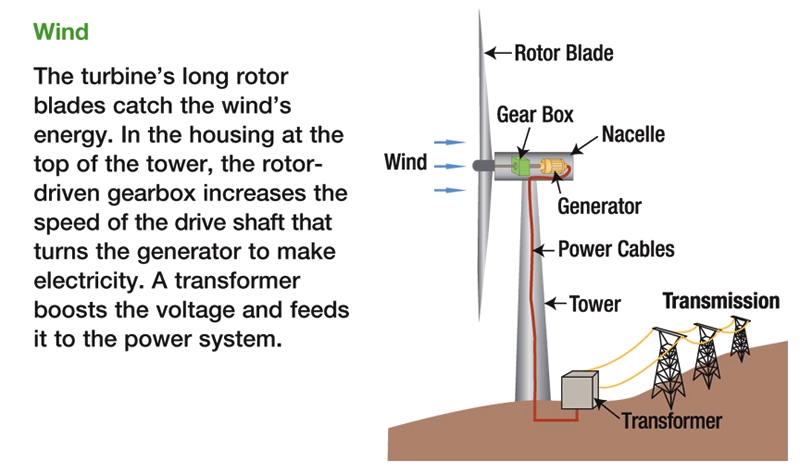
Wind energy
India has great potential of wind power.
1. The largest wind farm cluster is located in Tamil Nadu fromNagarcoil to Madurai.
2. Jaisalmer Is well known for effective use of wind energy in the country.
14
Tidal energy
Floodgate dams are built across inlets. During high tide water flows into the
inlet and gets trapped when the gate is closed.
After the tide falls outside the flood gate, the water retained by the floodgate flows back to the sea via a pipe that carries it through a
power-generating turbine.
In India the Gulf of Khambhat, the Gulf of Kuchchh in Gujarat on the western coast and Gangetic delta in Sunderban regions of West Bengal provide ideal conditions for utilising
tidal energy.
15
Geo Thermal Energy
1. Parvati valley near
Manikarn in Himachal Pradesh
2. Puga Valley, Ladakh.


Note:
Kudre in Kannada means horse. The highest peak in the western ghats of Karnataka resembles the face of a horse. The Bailadila hills look like the hump of an ox, and hence its name. Kudremukh
deposits are known to be one of the largest in the world. The ore is transported as slurry through a pipeline to a port near Mangaluru.
Very high grade hematite Iron ore from Bailadila range of hills mines is exported to Japan and South Korea via Vishakhapatnam port.
Due to its excellent di-electric strength, low power loss factor, insulating properties and resistance to high voltage, mica is one of the most indispensable minerals used in electric and electronic industries.
Coal mining in Jowai and Cherapunjee is done by family member in the form of a long narrow tunnel, known as ‘Rat hole’ mining.

After the discovery of aluminium Emperor Napoleon III wore buttons and hooks on his clothes made of aluminium and served food to his more illustrious guests in aluminium utensils and the less honourable ones were served in gold and silver utensils. Thirty years after this incident aluminium bowls were most common with the beggars in Paris.
Firewood and cattle dung cake are most common in rural India. According to one estimate more than 70 per cent energy requirement in rural households is met by these two.


Thursday, 25 July 2013

QUIZ 3 HISTORY OF RAJASTHAN

            CULTURAL HERITAGE OF RAJASTHAN AND ITS CONSERVATION

1.         Tomb of Khwaja Moin-ud-din-chisti (also known as “Garib-Nawaz”) is situated in :
            (A) Ajmer                       (B) Jodhpur                    (C) Pali                           (D) Sirohi

2.         Which one of the following is the literal meaning of “Kalibanga” a place of ancient source of Rajasthan’s history located near Ghaggar river in Hanumangarh district:
            (A) Black bangles                                                 (B) Black soil
            (C) Black tribes                                                     (D) Black mountains

3.         Which among the following city was contemporary of Harappan & Mohenjodaro sites?
            (A) Kalibanga                 (B) Bagore                     (C) Patliputra                    (D) Ujjain

4.         Fire alters, use of burnt bricks and signs of ancient ploughing field has been founded in:
            (A) Pilibanga                  (B) Kalibanga                 (C) Ahar                          (D) Alamgirpur

5.         In which of the following districts, the ancient Rajasthan culture place "Bagor" is situated:
            (A) Chittorgarh               (B) Bhilwara                   (C) Ajmer                        (D) Tonk

6.         Which lake is said to constructed by digging it with the nails of Gods ?
            (A) Nakki Lake                                                      (B) Annasagar Lake      
            (C) Pichhola Lake                                                 (D) Sambhar Lake

7.         Ahar civilization, which was about 4000 years old, flourished in which district of Rajasthan?
            (A) Sirohi                        (B) Udaipur                    (C) Barmer                     (D) Bhilwara

8.         Which statements is/ are incorrect about Ahar civilization?
            1. Ahar civilization developed on the banks of river Ahar (a tributary of Banas)
            2. In Ahar the houses were built of stones
            3. It was a copper Age civilization
            (A) 1 is correct                                                      (B) 2 is correct               
            (C) 3 is correct                                                      (D) All are correct

9.         In which of the following districts the ancient centre of developed culture of 'Noh' (1100 BC) is situated:
            (A) Dholpur                    (B) Alwar                        (C) Karauli                      (D) Bharatpur

10.       The Bhabru incription of Ashoka was discovered at :-
            (A) Viratnagar                (B) Nagri                        (C) Ujjain                        (D) Bharatpur

11.       Who of the following constructed the fort of Chittorgarh?
            (A) Chitrangad Maurya                                        (B) Shiladitya and Pushpwati
            (C) Maharana Lakha                                            (D) Maharana Kumbha

12.       Which city is called the city of lakes :
            (A) Jaipur                       (B) Udaipur                    (C) Jodhpur                    (D) Bikaner


13.       In which city, the Dhai Din ka Jhonpra, a mosque built by Ghori in 1193 A. D. is located:
            (A) Ajmer                       (B) Pali                           (C) Jaipur                       (D) Nagaur

14.       On which of the following hill of the Aravalli ranges the fort of Taragarh was bult by Ajai Raj Chauhan in the second decade of 12th century ?
            (A) Harsh Parwat                                                  (B) Kokla hill                  
            (C) Jarga Parwat                                                  (D) Guru Shikhar

15.       Taragarh Fort in Ajmer was built by Ajairaj Chauhana is also known as :
            (A) Garh Beethly            (B) Nahargarh                (C) Achalgarh                 (D) Chittorgarh

16.       Which of the following was not an achievement of Rana Kumbha :
            (A) He built 32 of the 84 forts of Mewar
            (B) He built victory tower namely 'Kirti Stambh', Kumbha Syam Temple and renovated the Ekling Temple
            (C) The Ranakpur Jain temple was made by Seth Dharanshah in his times
            (D) He extended his kingdom upto Delhi

17.       “Vijay Stambh” and “Kirti Stambh” are situated at :
            (A) Kota                          (B) Jhalawar                  (C) Chittorgarh               (D) Sirohi

18.       Rana Kumbha built the famous “Victory Tower” (Vijya Stambha) to commemorate the victory of :
            (A) Sirohi                        (B) Malwa                      (C) Bundi                        (D) Delhi 

19.       Who among the following built “Tower of Victory” (Vijay Stambha) in Chittorgarh ?
            (A) Mahrana Pratap                                              (B) Maharana Sanga
            (C) Maharana Amar Singh                                   (D) Mahrana Kumbha

20.       Who built Ranakpur jain temples during Kumbha’s reign ?
            (A) Somsunder              (B) Jai Chandsuri           (C) Seth Dharanshah     (D) Somdeo

21.       The Astronomical Observatory “jantar mantar” is located at :
            (A) Alwar                        (B) Jaipur                       (C) Ajmer                        (D) Udaipur

22.       Gaitor situated in down hills of fort Nahargarh attracts the tourist because of its:
            (A) Temples                   (B) Palaces                    (C) Forts                         (D) Cenotaphs

23.       Toad Rock is situated at :
            (A) Chittorgarh               (B) Ajmer                       (C) Durg                         (D) Mount Abu

24.       Which among the following is known as” Khajrao of Rajasthan” in Barmer?
            (A) Khanwa                    (B) Kiradu                       (C) Osian                        (D) Chawand

25.       The famous Dilwara temple is related with the:
            (A) Buddhism                 (B) Jainsim                     (C) Sikhism                    (D) Hindusim

26.       Which of the following “Haveli” a world fame architectural building is situated in Jaisalmer ?
            (A) Salim Singh Ki Haveli                                     (B) Nathmal Ki Haveli   
            (C) Patwon Ki Haveli                                            (D) All the above

27.       Famous cenotaph with eighty four pillars is situated at :
            (A) Kota                          (B) Jhalawar                  (C) Jaipur                       (D) Bundi

28.       The fomous Ranakpur Jain temples are located in the district of:
            (A) Chittorgarh               (B) Ajmer                       (C) Durg                         (D) Pali

29.       Match the following:
            (A) Sonar Kila                (1) Jaisalmer
            (B) Taragarh                  (2) Ajmer
            (C) Lohagarh                  (3) Bharatpur                 
            (D) Kalibanga                 (4) Hanumangarh
            Answer code:
            (A) A-2, B-1, C-4, D-3                                           (B) A-2, B-4, C-1, D-3   
            (C) A-1, B-2, C-3, D-4                                          (D) A-3, D-2, C-4, D-1

30.       Tomb of Khwaja Moin-ud-din-chisti (also known as “Garib-Nawaz”) is situated in :
            (A) Ajmer                       (B) Jodhpur                    (C) Pali                           (D) Sikar

31.       Name the temple of Rajasthan where rats are considered sacred:
            (A) Neel Kanth Mandir                                          (B) Savitri Temple
            (C) Bajrang Garh                                                  (D) Karni Mata Temple

32.       The city of Jaipur was established by Swai Jai Singh II in the year:
            (A) 1871                         (B) 1727                         (C) 1735                         (D) 1927

33.       Taragarh fort is situated in:
            (A) Nagore                     (B) Abu                           (C) Ranthambore           (D) Bundi

34.       Mehrangarh Fort is situated in;
            (A) Jaipur                       (B) Udaipur                    (C) Ranthambore           (D) Jodhpur

35.       Which place in Jodhpur is famous for early medieval temples of Jains and Hindus?
            (A) Gogamedi                (B) Abu                           (C) Karauli                      (D) Osian

36.       Which of the following forts is on the banks of the Kali Sindh?
            (A) Khumbhalgarh         (B) Jalore                       (C) Jaigarh                        (D) Gagron

37.       Which of the following forts was built by Raja Suraj Mal?
            (A) Lohagarh                  (B) Sivana                      (C) Ranthambhor           (D) Mehrangarh

38.       Which of the following forts is located in Sawai Madhopur?
            (A) Ranthambhor           (B) Sivana                      (C) Lohagarh                  (D) Mehrangarh

39.       Which of the following is also called the Sonnar fort?
            (A) Jaisalmer fort           (B) Bikaner fort              (C) Sivana                      (D) Lohagarh

40.       Achalgarh fort was built by
            (A) Raja Jai Singh                                                 (B) Thakur Shiv Singh
            (C) Rana Kumbha                                                (D) Nikumbh warriors

41.       Which of the following was captured by Alla-Ud-Din Khalji during the Jalore attack?
            (A) Sivana fort                                                      (B) Junagarh fort
            (C) Lohagarh fort                                                  (D) Jaisalmer fort

42.       Mandalgarh fort was built by
            (A) Pridhvi Raj                                                      (B) the Chauhans of Shakambari
            (C) Rao Jhodha                                                    (D) Suraj Mal

43.       Which of the following was built by Rawal Jaisal Bhati?
            (A) Bikaner fort                                                     (B) Sonnar fort
            (C) Bhatner fort                                                     (D) Ranthambhor

44.       Which of the following forts is known as the Guard of the North Border?
            (A) Mandalgarh              (B) Bhatner                    (C) Bikaner                     (D) Taragarh

45.       Match the forts and their locations.
            (1) Achalgarh                                                        (a) Chittorgarh
            (2) Jaigarh                                                             (b) Abu
            (3) Rang Mahal                                                     (c) Jaipur
            (4) Padmini Mahal                                                (d) Amber Fort
            Choose the answer from the options.
            (A) 1 – b                         ; 2 – c                             ; 3 – d                              ;  4 - a
            (B) 1 – a                         ; 2 – b                             ; 3 – c                              ;  4 - d
            (C) 1 – d                         ; 2 – a                             ; 3 – b                              ;  4 - c
            (D) 1 – c                         ; 2 – d                             ; 3 – a                              ;  4 - b

46.       It was built by Swai Pratap Singh in 1799:
            (A) Jantar Mantar          (B) Hawa Mahal             (C) Nahargarh Fort         (D) Taragarh

47.       Umaid Bhavan Palace is situated in:
            (A) Jaipur                       (B) Jodhpur                    (C) Jaisalmer                  (D) Kota

48.       Which city is known as “ Venice of East”?
            (A) Ajmer                       (B) Jodhpur                    (C) Pali                           (D) Udaipur

49.       The Jantar Mantar is a collection of architectural astronomical instruments, built by Sawai Jai Singh at five places in India:
            (1) Jaipur                        (2) Delhi                         (3) Ujjain                        
            (4) Varanasi                   (5) Mathura                    (6) Jodhpur
            Which is incorrect?
            (A) 3                               (B) 4                               (C) 5                                              (D) 6   

50.       Who among the following built Mehrangarh Fort?
            (A) Man Singh                                                       (B) Rao Jodha                 
            (C) Rai Singh                                                        (D) Udai Singh

51.       According to Shukra policy how many types of forts are there?
            (A) 3                               (B) 4                               (C) 7                                              (D) 9   

52.       Which region of Rajasthan has artistic palatial Havelies?
            (A) Dhudand region                                              (B) Marwar region         
            (C) Alwar                                                               (D) Shekhawati region

53.       Match the following:
            (A) Dilwara temple         (1) Ajmer
            (B) Ranakpur temple     (2) Mount Abu
            (C) Pushkar                   (3) Udaipur                    
            (D) Jaisamand Lake      (4) Pali
            Answer code:
            (A) A-2, B-1, C-4, D-3                                           (B) A-2, B-4, C-1, D-3   
            (C) A-1, B-2, C-3, D-4                                          (D) A-3, D-2, C-4, D-1

54.       Junagarh fort is in:
            (A) Nagore                     (B) Abu                           (C) Ranthambore           (D) Bikaner

55.       Brahma temple is situated in:
            (A) Puskar                      (B) Jaipur                       (C) Pali                           (D) Sirohi

Answer Key:
01        (A)                   02        (A)                   03        (A)                   04        (B)                   05(B)
06        (A)                   07        (B)                   08        (D)                   09        (D)                   10(A)
11        (A)                   12        (B)                   13        (A)                   14        (B)                   15(A)
16        (D)                   17        (C)                   18        (B)                   19        (D)                   20(C)
21        (B)                   22        (D)                   23        (D)                   24        (B)                   25(B)
26        (D)                   27        (D)                   28        (A)                   29        (C)                   30(A)
31        (D)                   32        (B)                   33        (D)                   34        (D)                   35(D)
36        (D)                   37        (A)                   38        (A)                   39        (A)                   40(C)
41        (A)                   42        (B)                   43        (B)                   44        (B)                   45(A)
46        (B)                   47        (B)                   48        (D)                   49        (D)                   50(B)
51        (D)                   52        (D)                   53        (B)                   54        (D)                   55(A)